




Getting your S corporation approved isn't the goal. Keeping it compliant is. I've seen business owners spend time and money setting up the right entity, only to lose some of the biggest benefits because they stopped paying attention after the paperwork was filed.
The good news is that maintaining an S corporation doesn't require a law degree or a full-time office manager. It just requires knowing what needs to be done and staying ahead of it. Here's the checklist I recommend every business owner review each year.
Your S Corporation Compliance Checklist
1. Keep Your Corporate Documents Up to Date
Every S corporation should have a complete and organized set of formation documents. That includes your Articles of Incorporation or Articles of Organization, bylaws or operating agreement, stock certificates or membership records when applicable, and documentation showing your S corporation election was properly filed with the IRS.
It's surprising how many business owners believe they have an S corporation, only to discover that Form 2553 was never filed or their business has fallen out of good standing with the state. Before you focus on tax strategies, make sure your entity was set up correctly and remains compliant.
2. Document Important Business Decisions
Running your business like a real business helps strengthen your liability protection.
If your business is organized as a corporation, annual shareholder and director meetings should be documented with corporate minutes. If your business is an LLC taxed as an S corporation, state law may not require annual meetings, but documenting major business decisions is still a smart practice.
Major purchases, loans, ownership changes, officer appointments, and other significant actions should all be reflected in your company records. Maintaining good documentation demonstrates that your business operates separately from you personally.
If you've fallen behind on your corporate records, don't panic. Get caught up and create a system that keeps everything current going forward.
3. Stay Current with Your State Filings
Every state has its own filing requirements for corporations and LLCs. Depending on where your business is organized, you may need to file an annual report, pay renewal fees, maintain a registered agent, or complete other periodic filings to remain in good standing.
Missing these deadlines can result in penalties, late fees, or even administrative dissolution of your business. Staying current with your state's requirements is one of the easiest ways to avoid unnecessary headaches.
4. Operate Through Your Business, Not Yourself
One of the biggest mistakes business owners make is treating the company and themselves as if they're the same thing. If you want the liability protection that comes with an S corporation, your business needs to look and operate like a separate legal entity.
Use your company's legal name on contracts, invoices, proposals, your website, business cards, advertising, and email signatures. Open dedicated business bank accounts and avoid mixing personal and business expenses. The more consistently you operate through your business, the stronger your liability protection becomes.
5. Pay Yourself Through Payroll
Payroll is one of the most important responsibilities of an S corporation owner.
The tax savings associated with an S corporation depend on paying yourself reasonable compensation before taking shareholder distributions. The IRS expects owners who actively work in the business to receive wages for the services they perform.
There isn't a magic formula that determines the right salary. Reasonable compensation depends on your responsibilities, experience, industry, profitability, and what someone else would earn performing similar work.
The Kohler Payroll Matrix is a planning tool I use to help business owners think about reasonable compensation. It isn't a formula, and it certainly isn't a substitute for professional advice. Every business is different, and the appropriate salary depends on factors like your industry, responsibilities, profitability, and what someone else would reasonably earn performing similar work.
Use the matrix as a conversation starter, not the final answer. The goal is to establish a salary that's both defensible and tax-efficient based on your specific circumstances.
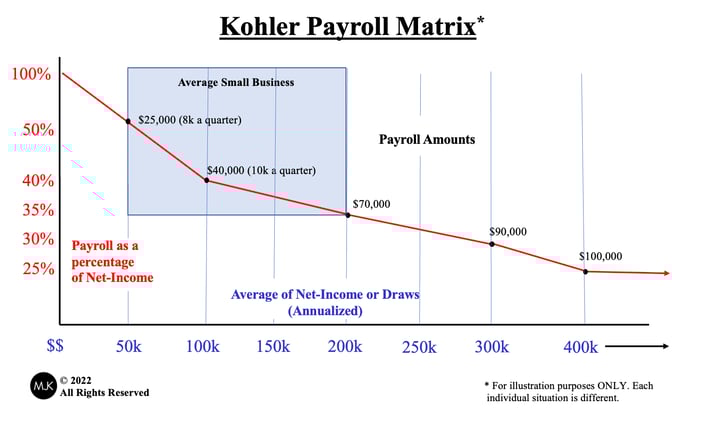
Once your salary has been established, make sure payroll tax deposits, quarterly payroll filings, and year-end W-2 reporting are completed accurately and on time. Proper payroll isn't just about saving taxes. It's what helps support the entire S corporation strategy.
6. Keep Accurate Books and File Your Tax Return on Time
Good bookkeeping makes every part of operating an S corporation easier.
Keeping your books current allows you to accurately track income, expenses, payroll, shareholder distributions, and business performance throughout the year. Waiting until tax season to organize your finances often leads to unnecessary stress and missed opportunities.
Your S corporation must also file Form 1120-S each year. Filing late can result in significant penalties, especially if there are multiple shareholders. If you need additional time, file an extension rather than missing the deadline altogether.
7. Understand Your State's Tax Requirements
Federal tax rules are only part of the picture. Many states recognize the federal S corporation election, but others impose additional franchise taxes, annual fees, minimum taxes, or separate filing requirements. Some states even require a separate state S corporation election.
Understanding your state's rules helps you avoid unexpected notices, penalties, and compliance issues later.
Common S Corporation Mistakes to Avoid
Even well-intentioned business owners can make costly mistakes when maintaining an S corporation. Some of the most common include:
- Forgetting to run payroll before taking distributions.
- Mixing personal and business finances.
- Missing annual state filings.
- Failing to maintain corporate records.
- Filing tax returns late.
- Assuming every state follows the same rules.
Avoiding these mistakes helps protect both your tax savings and the long-term health of your business.
-1.png?width=791&height=206&name=S%20Corp%20Secrets%20the%20Wealthy%20Use%20(And%20How%20You%20Can%20Too!)-1.png)
The Bottom Line
An S corporation can be one of the most valuable tax-saving tools available to a business owner, but only if it’s maintained properly. Missing payroll requirements, overlooking annual filings, or ignoring compliance responsibilities can quickly erase the tax benefits that made the S corporation worthwhile in the first place.
The good news is that most compliance issues are easy to prevent when you have the right systems in place. A little attention throughout the year can save thousands of dollars in taxes, penalties, and cleanup costs later.
If you’re unsure whether your S corporation is fully compliant or whether you’re taking advantage of every legitimate tax-saving opportunity available, book a Comprehensive Tax and Business Consultation with my law firm, KKOS Lawyers. We can review your current structure, payroll, deductions, and overall tax strategy to identify potential problems and make sure your S corporation is actually working the way it was designed to.
Don’t wait for an IRS notice, missed deadline, or expensive cleanup project to find out your S corporation wasn’t being maintained correctly. Protect the tax savings you created it for in the first place.
.png?width=6440&height=1438&name=KKOS%20Book%20a%20Call%20(2).png)
Frequently Asked Questions
Do I have to pay myself a salary if I own an S corporation?
If you actively work in the business, the IRS generally expects you to receive reasonable compensation through payroll before taking shareholder distributions.
What happens if my S corporation falls out of good standing?
Depending on your state's rules, your business may face penalties, administrative dissolution, or additional filings and fees to restore good standing.
Does an LLC taxed as an S corporation need annual meetings?
State laws vary, but documenting important business decisions and maintaining company records is always a good practice. If your business is organized as a corporation, annual meetings and minutes are generally required.
Can I take only distributions and skip payroll?
No. Owners who perform services for their S corporation are generally required to receive reasonable compensation before taking shareholder distributions.
What tax return does an S corporation file?
An S corporation files IRS Form 1120-S, and each shareholder receives a Schedule K-1 reporting their share of the company's income, deductions, and credits.
How often should I review my S corporation compliance?
At a minimum, review your compliance annually. However, it's also a good idea to revisit your payroll, bookkeeping, and state filing requirements throughout the year, especially if your business experiences significant growth or changes.