




Trusts can save your family time, money, and a tremendous amount of stress, but don't make the mistake of assuming every trust saves taxes. Every trust is taxed differently because every trust is designed to do something different. Before you decide which trust is right for you, make sure you're solving the right problem. A tax benefit is great when it exists, but it should never be the only reason you create a trust.
How Are Trusts Taxed?
One of the first questions I get about trusts is whether they pay taxes at all. The answer is yes, but there isn't one set of tax rules that applies to every trust. Depending on how it's structured, a trust may be subject to income tax, and certain trusts can also be used as part of an estate or gift tax strategy. The way those taxes are handled depends primarily on whether the trust is revocable or irrevocable because those two trusts are designed to accomplish very different goals.
Revocable Living Trusts
If you've followed me for any length of time, you already know I'm a big fan of revocable living trusts. For most families, it's where I like to start because it solves the problems people are most likely to face without creating unnecessary complexity.
From an income tax standpoint, a revocable living trust is about as simple as it gets. Since you retain complete control over the trust and its assets, the IRS treats you and the trust as the same taxpayer. Interest, dividends, rental income, business income, capital gains, and every other type of taxable income generated by the trust simply flow onto your personal Form 1040.
That means there isn't a separate trust income tax return while you're alive, and there aren't additional tax brackets or filing requirements to worry about. The trust changes how your assets are managed and transferred, but it doesn't change how you're taxed.
Some people are surprised to hear that because they assume putting assets into a trust automatically creates tax savings. That's just not what a revocable living trust was designed to do. Its greatest strengths are avoiding probate, protecting your privacy, and allowing someone you choose to step in and manage your affairs if you become incapacitated. Those advantages alone make it one of the best estate planning tools available for the vast majority of families.
Irrevocable Trusts
Irrevocable trusts require a different conversation because they're built for different objectives. Once assets are transferred into most irrevocable trusts, you've generally given up some level of ownership or control over those assets. Because of that, the IRS usually recognizes the trust as its own taxpayer.
In most cases, the trust receives its own taxpayer identification number, files IRS Form 1041, and reports income earned by trust assets. If the trust retains that income, the trust generally pays the tax. If the trustee distributes taxable income to beneficiaries, it's typically reported on a Schedule K-1, and the beneficiaries include that income on their own tax returns.
One important point that's often overlooked is how quickly trusts reach the highest federal income tax bracket. Unlike individuals, trusts move through the brackets much faster. That doesn't make an irrevocable trust a bad idea, but it does mean trustees need to think carefully about whether income should remain inside the trust or be distributed to beneficiaries. For tax year 2026, the federal income tax rates are:
|
Tax Rate |
Taxable Income |
|
10% |
$0 to $3,300 |
|
24% |
$3,301 to $11,700 |
|
35% |
$11,701 to $16,000 |
|
37% |
Over $16,000 |
Irrevocable trusts can also become part of a larger estate and gift tax strategy. Depending on the type of trust and your long-term goals, they may help transfer appreciating assets to the next generation, support charitable giving, or reduce the size of a taxable estate. Those benefits aren't automatic, and they aren't the reason every family needs an irrevocable trust, but they can be incredibly valuable when the trust is being used for the right purpose.
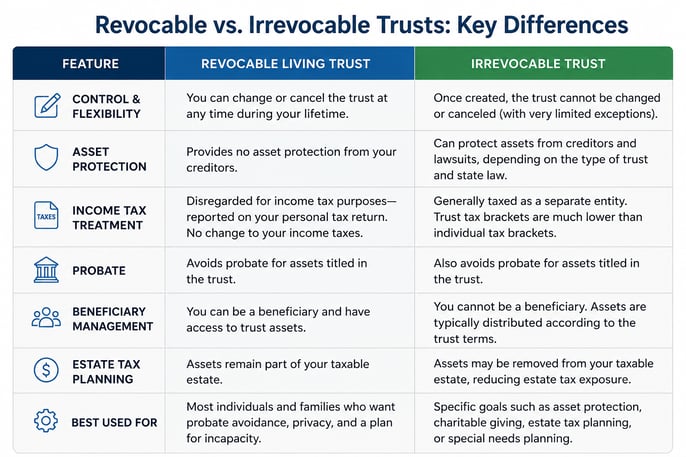
Understanding the difference between revocable and irrevocable trusts helps explain why two trusts holding nearly identical assets can have completely different tax consequences. That's why I always recommend choosing a trust based on your planning goals first. Once you've identified the problem you're trying to solve, selecting the right trust and understanding its tax treatment becomes much more straightforward.
Do Trust Beneficiaries Pay Taxes?
One of the biggest concerns people have is whether their children or other beneficiaries will owe taxes when they inherit assets from a trust. The answer depends on what they're actually receiving.
If a beneficiary receives a distribution of the trust's principal, meaning assets that were originally placed into the trust, those distributions generally aren't taxable. Simply inheriting money or property from a trust doesn't automatically create an income tax bill.
The rules are different when the trust distributes taxable income. Interest, dividends, rental income, and certain business income generated inside the trust may be taxable to the beneficiary if those amounts are distributed. In those situations, the beneficiary will typically receive a Schedule K-1 showing the income that must be reported on their personal tax return.
This is why two beneficiaries receiving distributions from the same trust can have completely different tax consequences. One may receive principal and owe no income tax, while another receives taxable income and must report it on their return. The trust document and the character of the distribution determine how it's taxed.
How Are Trust Distributions Taxed?
Not every dollar that leaves a trust is treated the same, and that's where people often get confused.
When a trustee makes a distribution, the first question is whether it's principal or income. Principal generally consists of the assets originally contributed to the trust or amounts already taxed. Income includes earnings generated by those assets after they've been placed in the trust.
For example, imagine a trust owns a rental property. The property itself is part of the trust's principal, but the monthly rental income generated by that property is income. If the trustee distributes rental income to a beneficiary, that income may be taxable. If the trustee later distributes ownership of the property itself according to the terms of the trust, that's an entirely different tax analysis.
The same concept applies to investment accounts. The stocks or mutual funds held inside the trust are principal. Dividends, interest, and other earnings generated by those investments are generally considered income.
Understanding that distinction helps beneficiaries avoid unnecessary surprises when tax season arrives.
What About Capital Gains?
Capital gains deserve special attention because they're handled differently than ordinary trust income.
When a trust sells appreciated assets, someone has to recognize the gain. Depending on the terms of the trust and how it's administered, that gain may remain taxable to the trust or, in certain situations, be passed through to beneficiaries. There isn't one rule that applies in every case.
This is one of the reasons trustees shouldn't make major investment decisions without first understanding the tax consequences. Selling a piece of appreciated real estate, a business interest, or a large investment portfolio can create a significant tax liability if the transaction isn't planned properly.
I've seen families focus entirely on getting the sale completed without stopping to ask whether there's a more tax-efficient way to structure it. That's a mistake that's often avoidable with a little planning beforehand.
Can You Reduce Taxes on a Trust?
Whether you're serving as a trustee or planning your own estate, trust taxes shouldn't be left on autopilot. The way income is earned, retained, and distributed can have a significant impact on the overall tax bill. While every trust is different, these are some of the most common strategies used to improve tax efficiency:
- Distribute Income Strategically. Because irrevocable trusts reach the highest federal income tax brackets much faster than individuals, distributing taxable income to beneficiaries in lower tax brackets may reduce the family's overall tax liability. Whether that makes sense depends on the beneficiaries, the trust's purpose, and the terms of the trust itself.
- Use Grantor Trust Rules When Appropriate. Certain irrevocable trusts are intentionally structured so the grantor continues paying the income tax on trust earnings. While that may sound counterintuitive, it allows more assets to remain inside the trust and continue growing for future beneficiaries without reducing the trust's value to pay the annual tax bill.
- Take Advantage of Available Deductions. In many cases, irrevocable trusts can deduct income that's distributed to beneficiaries. Those deductions may reduce the amount of taxable income remaining inside the trust, creating opportunities for more efficient tax planning.
- Plan Capital Gains Before You Sell. Selling appreciated real estate, stocks, or other investments inside a trust can create a significant tax bill. Before completing the sale, review the transaction with your tax advisor to determine whether it's more beneficial for the trust or a beneficiary to recognize the gain.
- Review Your Trust as Tax Laws Change. Estate planning isn't a one-and-done exercise. Tax laws change, family circumstances change, and your assets change over time. Reviewing your trust periodically with your estate planning attorney and tax advisor helps ensure your strategy continues to accomplish your goals while taking advantage of current tax laws.
Why I Recommend Revocable Living Trusts for Most Families
People assume that because irrevocable trusts are more complex, they must be better. I don't agree with that.
For the overwhelming majority of families, a revocable living trust checks all the boxes. You keep complete control over your assets while you're alive, you can amend or revoke the trust whenever your circumstances change, and your family avoids the time, expense, and frustration that often comes with probate.
Just as important, a revocable trust creates a plan for incapacity. If something happens to you, the successor trustee you've chosen can immediately step in and manage your financial affairs without asking a judge for permission. That's one of the most overlooked benefits of a revocable living trust, and I've seen firsthand how much stress it can save a family during an already difficult time.
Irrevocable trusts absolutely have a role in estate planning. We use them regularly for clients with advanced planning needs, significant asset protection concerns, charitable giving objectives, or large estates that require more sophisticated strategies. But I don't recommend them simply because they're more complex. Complexity doesn't automatically create value. The best estate plan is the one that accomplishes your goals without creating unnecessary complications.
Common Misunderstandings About Trust Taxation
I've found that trust taxation becomes much less intimidating once you separate fact from fiction. Unfortunately, there's a lot of bad information floating around online, and I regularly meet clients who have been given advice that simply isn't true.
One misconception is that every trust files its own tax return. That's only true for many irrevocable trusts. A revocable living trust generally doesn't require a separate income tax return while the grantor is alive because all of the income is reported on the grantor's personal return.
Another misconception is that putting assets into a trust automatically eliminates taxes. Trusts don't create a magical tax-free environment. Depending on the type of trust, someone is still paying the income tax, whether that's the grantor, the trust itself, or the beneficiaries receiving distributions.
I also hear people say they don't want a trust because they've heard beneficiaries have to pay taxes on everything they inherit. That's not how it works. Beneficiaries may pay tax on certain types of income distributed by a trust, but inheriting assets doesn't automatically create an income tax bill. Understanding the difference between trust principal and trust income makes all the difference.
The Bottom Line
The biggest estate planning mistakes don’t happen after you’re gone. They happen because no one took the time to build the right plan while you were alive. The wrong trust can cost your family time, money, privacy, and unnecessary stress. The right trust can protect everything you’ve spent a lifetime building.
Don’t leave that decision to chance. Book a Comprehensive Estate Planning Service with my law firm, KKOS Lawyers. We can look at your family, assets, business interests, beneficiaries, and long-term goals to determine which trust belongs in your plan and how the entire estate plan should work together.
Your family deserves more than a generic trust document. They deserve a strategy built to protect what you’ve spent a lifetime creating.
.png?width=6440&height=1438&name=KKOS%20Book%20a%20Call%20(2).png)
Frequently Asked Questions
Does a revocable living trust file its own tax return?
Generally, no. During your lifetime, a revocable living trust is treated as an extension of you for income tax purposes. The trust's income is reported on your personal tax return, so there usually isn't a separate Form 1041 filing requirement.
What tax return does an irrevocable trust file?
Most irrevocable trusts file IRS Form 1041, U.S. Income Tax Return for Estates and Trusts. If taxable income is distributed to beneficiaries, the trust generally issues a Schedule K-1 so each beneficiary knows what income must be reported on their individual return.
Can a trust reduce estate taxes?
Certain irrevocable trusts can be valuable estate tax planning tools, but they aren't necessary for every family. Whether an estate tax strategy makes sense depends on the size of your estate, the assets you own, and your long-term planning goals. That's a conversation worth having before you create the trust, not after.
Which trust is best for most families?
For most families, I recommend starting with a revocable living trust. It gives you flexibility, keeps you in control of your assets, avoids probate, and provides a clear plan if you become incapacitated. More advanced trusts certainly have their place, but they're usually designed to solve very specific planning issues rather than replace a revocable trust altogether.
Should I put all of my assets into a trust?
Not necessarily. Some assets transfer directly through beneficiary designations or have their own planning considerations. Your trust should work together with your overall estate plan, not replace every other planning tool you have. Funding your trust properly is just as important as creating it in the first place, which is why I always recommend reviewing your asset ownership with your estate planning attorney.