

The final months of the year are critical for retirement and tax planning. Some of the biggest retirement and tax-saving opportunities have a December 31 deadline, and if you don't take action before year-end, you could miss out on thousands of dollars in tax savings and retirement contributions. I like to think of retirement planning as a stack, starting with the strategies that offer the greatest immediate benefit and building from there based on your income, business, family, and long-term goals. Whether you're a W-2 employee, a business owner, or both, here are the retirement moves you need to consider before December 31, 2026.
1. Maximize Your Employer 401(k) Match Before December 31
If you or your spouse has a W-2 job with an employer-sponsored 401(k), this is where I want you to start.
When your employer offers a matching contribution, that's one of the easiest ways to accelerate your retirement savings. Let's say you earn $100,000 annually and your employer matches your contributions up to 4% of your salary. You contribute $4,000, and your employer contributes another $4,000. That's $8,000 going into your retirement account, with half of it coming directly from your employer. Where else are you going to get that kind of immediate return on your contribution?
But here's where the December 31 deadline matters. Employee 401(k) contributions generally need to come out of your paycheck during the calendar year. If you haven't contributed enough to receive your full employer match, you may still have time to increase your contributions through your remaining paychecks.
Call your HR department or payroll administrator and ask:
- How much have I contributed to my 401(k) so far in 2026?
- How much of my employer's matching contribution have I received?
- Can I increase my contributions through my remaining paychecks to maximize the match?
Keep in mind that every employer's matching formula is different. Some plans calculate matching contributions paycheck by paycheck, while others offer a year-end true-up. You need to understand how your particular plan works before making changes.
For 2026, the standard employee 401(k) contribution limit is $24,500, with additional catch-up contributions available for eligible older workers. That limit generally applies across your employee elective deferrals to multiple 401(k) plans.
My strategy is simple: Match out first. Get the full employer contribution available to you, then evaluate where your next retirement dollar should go.
Your workplace 401(k) may offer a limited selection of mutual funds or other investments. Once you've secured the employer match, you can consider additional retirement accounts that offer different tax benefits and investment options.
2. Complete Your 2026 Roth Conversions
A Roth conversion is one of the most important retirement planning decisions to evaluate before December 31.
When you convert money from a traditional IRA or eligible pre-tax retirement account into a Roth account, you're generally choosing to pay income taxes on the converted amount now in exchange for the potential for tax-free qualified withdrawals later.
Why would you voluntarily pay taxes today? Because you may be in a lower tax bracket now than you expect to be in the future. You may also have investments that have temporarily declined in value, giving you an opportunity to convert at a lower taxable amount.
But there's another strategy I want you to understand: chunking your Roth conversions across multiple tax years.
Let's say you have $200,000 in a traditional IRA and want to move that money into a Roth IRA. You could convert the entire $200,000 in 2026, but that additional taxable income might push a substantial portion of your income into a higher federal tax bracket. Instead, you could convert $100,000 before December 31, 2026, and consider converting the remaining $100,000 in 2027. Now you've spread the taxable income across two different years instead of concentrating it into one.
Of course, $100,000 isn't necessarily the right amount for you. Depending on your income, deductions, filing status, and other circumstances, the appropriate conversion could be $20,000, $50,000, or another amount entirely. That's why I want you to be surgical about Roth conversions. Look at your projected taxable income, identify where the next tax bracket begins, and determine how much you can reasonably convert.
And remember, Roth conversions can affect more than your federal income tax bracket. They can also influence state income taxes, Medicare premiums, and other income-based calculations.
The deadline: If you want a Roth conversion included in your 2026 tax year, it needs to be completed by December 31, 2026. You can't complete a conversion in April 2027 and retroactively assign it to 2026. This is one of those strategies where planning ahead can make an enormous difference.
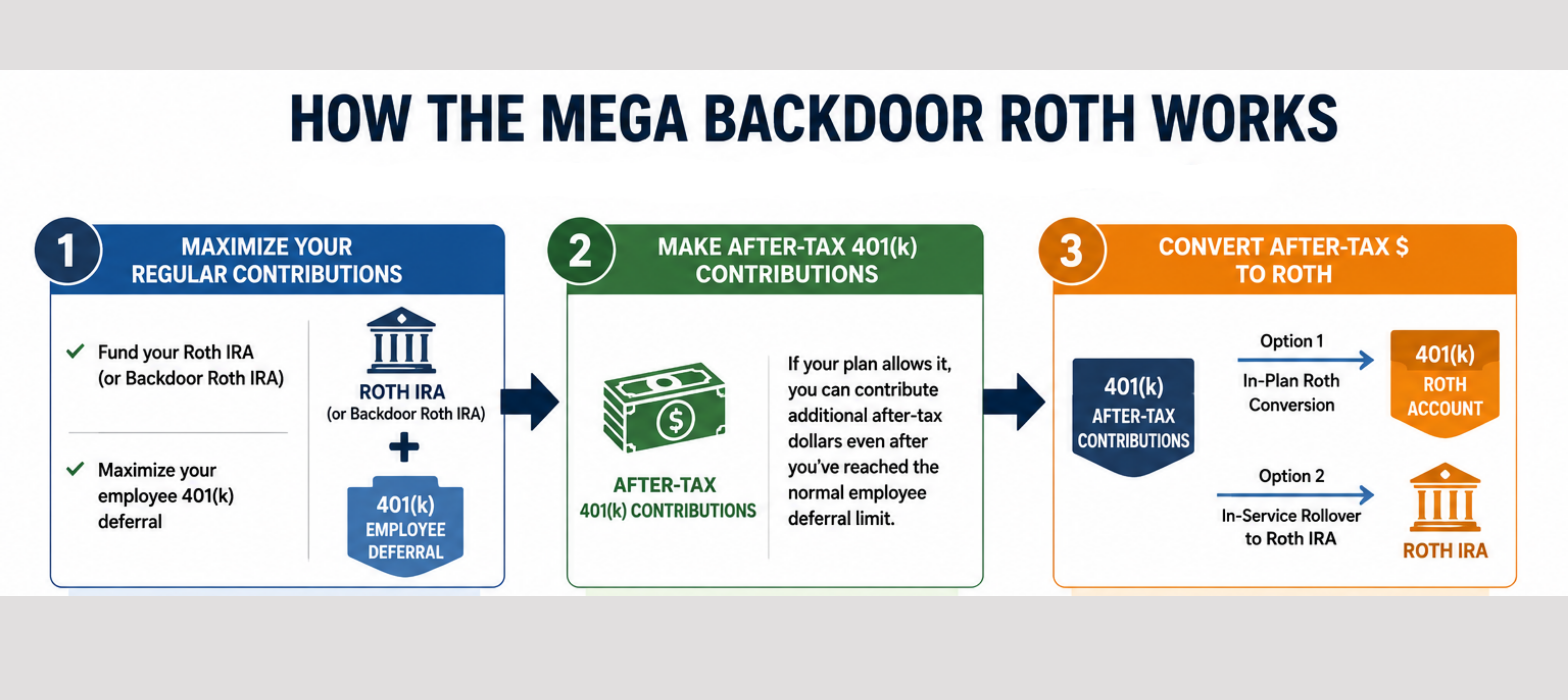
3. Take Advantage of the Mega Backdoor Roth
If you've already maximized your regular 401(k) contributions and want to put even more money into Roth accounts, the mega backdoor Roth deserves a serious look.
For 2026, the standard employee elective deferral limit for a 401(k) is $24,500. But the overall annual additions limit for defined contribution plans is $72,000, excluding eligible catch-up contributions. That larger limit includes applicable employee contributions, employer contributions, and certain after-tax contributions.
Here's where the opportunity comes in. Some employer 401(k) plans allow employees to make additional, non-Roth after-tax contributions beyond their regular elective deferrals. If the plan also permits eligible Roth conversions or distributions, those after-tax contributions can potentially be moved into a Roth account. That's the foundation of the mega backdoor Roth strategy.
For example, let's say you're under age 50 and contribute $24,500 through your regular 401(k) deferrals. Your employer contributes another $7,500. That brings your combined contributions to $32,000. If your plan permits the strategy and you otherwise qualify, you could potentially make up to $40,000 in additional after-tax contributions before reaching the $72,000 annual additions limit. Those after-tax dollars could then be converted to Roth, subject to the plan's rules. Any associated pre-tax earnings may create a taxable amount when converted.
That's a tremendous opportunity to build additional Roth retirement savings, but not every employer plan allows it.
Before December 31, contact your plan administrator and ask:
- Does my 401(k) allow voluntary after-tax employee contributions separate from Roth elective deferrals?
- Does the plan permit in-plan Roth conversions or eligible distributions to a Roth IRA?
- How much room do I have remaining under the annual contribution limits?
- What are the deadlines for making contributions and completing any conversions?
The deadline: After-tax employee contributions intended for the 2026 plan year generally need to be made under the plan's applicable year-end payroll and contribution procedures. A Roth conversion itself may be completed later, depending on the plan, but the conversion year determines its tax treatment. If your employer offers this opportunity, it's worth investigating before the year ends.
And just a note. Don't confuse the mega backdoor Roth with the regular backdoor Roth IRA. They're two different strategies with different rules and contribution limits.
4. Get Your Solo 401(k) Strategy in Place
Now let's talk to the entrepreneurs, independent contractors, consultants, and small business owners.
If you have self-employment income, even from a side business, a Solo 401(k) can be one of the most powerful retirement planning tools available. I love the Solo 401(k) because it gives eligible business owners more control over their retirement contributions and investment options.
Think about someone who has a full-time W-2 job at a hospital but also earns consulting income on the side. That individual may be able to participate in the hospital's 401(k) and establish a separate Solo 401(k) for the consulting business.
You can have more than one 401(k), but your employee elective deferral limit generally applies across your plans. The real opportunity with a Solo 401(k) comes from being able to contribute in two different capacities: as an employee and as the business owner.
For 2026, the combined annual additions limit can reach $72,000, excluding eligible catch-up contributions. But the amount you can actually contribute depends on your eligible compensation, business income, entity structure, other plan contributions, and applicable rules.
If your spouse legitimately works in the business and qualifies to participate, your spouse may also be able to make contributions based on their compensation. That can create substantial retirement savings opportunities for a family.
Don't Overlook the Solo 401(k) Rollover Strategy
There's another reason I like having a Solo 401(k) available.
Let's say you have an old traditional IRA containing pre-tax money from a previous employer's retirement plan. You want to use the backdoor Roth IRA strategy, but you're concerned about the IRS pro-rata rule. Under that rule, your existing traditional, SEP, and SIMPLE IRA balances can affect how much of a Roth conversion is taxable.
An eligible Solo 401(k) that accepts incoming rollovers may allow you to move certain pre-tax IRA funds into the plan. That can help you manage the traditional IRA balances considered under the pro-rata calculation. You don't necessarily have to convert all your old IRA money to Roth to use the backdoor Roth strategy.
However, you need to confirm that the Solo 401(k) accepts the rollover, that you're eligible for the plan, and that the transaction is completed correctly. Timing matters because the pro-rata calculation generally considers relevant IRA balances on December 31 of the conversion year.
Why You Should Act Before December 31
Solo 401(k) deadlines are more complicated than they used to be. Certain eligible business owners can establish a plan after year-end and still make qualifying contributions for the previous tax year. However, the rules differ depending on whether you're operating as a sole proprietor, an S corporation, or another entity.
For S corporation owners in particular, employee deferrals generally need to be coordinated with compensation and payroll for the applicable year. Waiting until tax season can mean losing opportunities that required action during 2026. That's why I recommend getting your Solo 401(k) established and your contribution strategy reviewed before December 31 whenever possible. You may have additional time under the law for certain contributions or plan adoption, but don't assume every contribution can wait until April.
And if you want the flexibility to self-direct your retirement investments, a properly structured Solo 401(k) can open the door to investment opportunities beyond traditional stocks and mutual funds, including certain real estate and private investments, subject to IRS rules.
5. Pay Your Children for Legitimate Work Before Year-End
This strategy isn't technically a retirement account deadline, but it's an important part of the family wealth-building discussion. If you own a business and your children are performing legitimate work, paying them before December 31 can create two potential benefits.
- Reasonable compensation for actual business services may qualify as a deductible business expense.
- Those wages can provide earned income that supports contributions to your child's own Roth IRA.
Let's say your teenager helps with bookkeeping, social media, administrative tasks, cleaning your office, or other legitimate responsibilities. You pay them a reasonable wage, document their work, and handle the payment according to the payroll and tax rules that apply to your business. Now your child has earned income and may be eligible to contribute to a Roth IRA.
For 2026, the IRA contribution limit is $7,500 for individuals under age 50, but your child can't contribute more than their eligible compensation for the year. And here's the part I love: the money invested in that Roth IRA has potentially decades to compound. Your child doesn't have to wait until adulthood to start building retirement wealth.
There are important rules here. The work must be real, compensation must be reasonable, and the applicable payroll taxes and reporting requirements depend on your business structure and your child's age. The special employment tax rules for children working in a parent's sole proprietorship don't automatically apply to S corporations.
The deadline: If you're using the cash method of accounting and want to deduct qualifying wages paid to your child in 2026, the payment generally needs to be made by December 31, 2026. The child's Roth IRA contribution itself can generally be made later, by the applicable 2026 IRA contribution deadline.
This is an opportunity to teach your children about work, investing, and building wealth while creating a legitimate tax planning strategy for your business.
Bonus: Important Retirement Moves That Can (But Shouldn't) Wait Until 2027
Not every retirement contribution has to be completed by December 31. Some of the most valuable opportunities remain available into the following year. But I don't want you waiting until April to start thinking about them. Once you've addressed your immediate year-end deadlines, these are the next layers I'd consider adding to your retirement savings stack.
Fund Your Roth IRA or Use the Backdoor Roth IRA
For 2026, the IRA contribution limit is $7,500 for individuals under age 50 and $8,600 for those age 50 or older, subject to eligible compensation and other applicable rules. If your income is too high to contribute directly to a Roth IRA, the backdoor Roth IRA strategy may provide another route. This involves making a nondeductible traditional IRA contribution and converting the money to a Roth IRA.
However, existing pre-tax IRA balances can create tax complications under the pro-rata rule, so review those balances before completing a conversion. You generally have until April 15, 2027, to make a 2026 IRA contribution.
And don't forget your spouse. If you're married and file jointly, a spouse without their own earned income may still qualify to make an IRA contribution based on the working spouse's compensation, subject to the applicable rules.
Maximize Your Health Savings Account (HSA)
An HSA is one of my favorite accounts for building long-term wealth. If you're eligible, you can contribute money on a tax-advantaged basis, invest the balance, and withdraw funds tax-free for qualified medical expenses. That's a powerful combination.
For 2026, the standard HSA contribution limits are $4,400 for self-only coverage and $8,750 for family coverage. Eligible individuals age 55 or older may also qualify for an additional $1,000 catch-up contribution. Your actual limit depends on your eligibility, coverage, and other factors.
And here's something I want you to understand: you don't have to spend the money in your HSA every year. You can invest it and allow the account to grow for future medical expenses, including expenses you may face during retirement.
You may also be able to reimburse yourself years later for qualifying medical expenses incurred after your HSA was established, provided those expenses haven't already been reimbursed or deducted and you maintain the necessary records.
Recent changes have also expanded HSA eligibility for certain health insurance arrangements beginning in 2026, making this a good time to review your coverage. Eligible 2026 HSA contributions can generally be made until April 15, 2027.

Fund Your Children's Roth IRAs
Remember, paying your children for legitimate work and contributing to their Roth IRAs are two separate steps. Your child needs qualifying earned income during 2026 to support a 2026 Roth IRA contribution. But the contribution itself can usually be made until April 15, 2027. You can even provide the money for the contribution, as long as your child has sufficient eligible compensation and meets the applicable requirements.
That's why I want business owners thinking about their children's compensation before December 31, even though the Roth contribution can wait.
Consider College Savings Without Sacrificing Your Retirement
If you have children or grandchildren, college savings should also be part of your family's financial planning. Coverdell Education Savings Accounts, 529 plans, and newer children's savings arrangements may offer additional opportunities, depending on your circumstances.
For 2026, eligible Coverdell ESA contributions can generally be made until April 15, 2027, while 529 plan deadlines and state tax benefits vary. But here's the principle I want you to remember: Don't sacrifice your own retirement to fund your children's education.
I've seen families pull money out of retirement accounts, trigger taxes and penalties, or take on additional debt because they didn't have a college savings strategy in place. Take care of your retirement first, then build a plan for helping your children.
The Bottom Line
The right retirement strategy can save you thousands in taxes and help you build serious long-term wealth, but timing is everything. Matching out your 401(k), making strategic Roth conversions, maximizing your Solo 401(k), and taking advantage of other retirement opportunities all require planning. Once December 31 passes, some of those opportunities are gone for the year.
Don't wait until December to get professional tax advice. Year-end planning takes time, and the closer we get to December 31, the harder it becomes to put these strategies into action. Book a Comprehensive Tax and Business Consultation with my law firm, KKOS Lawyers. We'll review your tax situation, identify the retirement opportunities you could be missing, and map out exactly what needs to happen before the deadlines hit. Our year-end consultation calendar fills up fast. Don't wait until it's too late to get the strategies, tax savings, and retirement opportunities you deserve.
Frequently Asked Questions
Can I make a 2026 401(k) contribution after December 31?
Employee elective deferrals to a workplace 401(k) generally must be made through eligible payroll for the 2026 calendar year. Certain employer contributions may have later deadlines, depending on the plan and business.
Can I make a Roth IRA contribution in 2027 for the 2026 tax year?
Yes. Eligible individuals generally have until April 15, 2027, to make a Roth IRA contribution designated for 2026, subject to the applicable income, compensation, and contribution limits.
What happens if I miss the December 31 Roth conversion deadline?
A conversion completed in 2027 generally counts as a 2027 conversion. You can't retroactively designate it as a 2026 Roth conversion.
Can I have a workplace 401(k) and a Solo 401(k) at the same time?
Yes, if you qualify for both plans. However, your employee elective deferral limit generally applies across your 401(k) plans, and additional contribution limits and rules may apply.
Do I need to convert my entire traditional IRA to use the backdoor Roth strategy?
No. You can convert a smaller amount, and an eligible rollover of certain pre-tax IRA funds into a qualified retirement plan may help manage the pro-rata calculation. Review your IRA balances and tax consequences before proceeding.
Should I prioritize my retirement savings or my children's college savings?
I generally recommend establishing a solid retirement savings strategy first. College savings accounts can help you prepare for education expenses, but withdrawing retirement funds early can create taxes, penalties, and long-term financial setbacks.