




What do you do when a rental property isn't performing the way you expected? Do you sell it, keep renting it, renovate it, or find another way to make it work? I've faced these decisions myself, and I can tell you they aren't easy. We borrow money, spend months improving a property, deal with tenants, and invest our hard-earned savings into making the investment successful. Before long, we're emotionally attached to the thing. We're practically married to it!
But sometimes you have to look at that property and say, "It's not me, it's you. Bye-bye." Other times, you just need to change the relationship. That's why I developed what I call the Problem Property Matrix, a straightforward framework to help real estate investors decide when to hold on, when to change their strategy, and when it's finally time to let a property go.
Why It's So Hard to Sell a Struggling Rental Property
Real estate investing involves a lot more than buying a property and collecting rent. You've probably spent years building equity, managing tenants, making improvements, and dealing with unexpected expenses. Maybe you bought the property with your spouse, inherited it from a family member, or worked incredibly hard to come up with the down payment. Whatever the circumstances, there's often a lot of emotion tied to that investment.
And when the property starts losing money, those emotions can make it difficult to see the situation clearly. You remember what you paid for it, what it used to be worth, and how much money you've already invested. You convince yourself that if you just hold on a little longer, the market will turn around and everything will work out.
Believe me, I understand. I've been investing in real estate for most of my adult life, and I lost properties during the 2008 financial crisis. I've had to make difficult decisions, including giving a property back to a lender through a deed in lieu of foreclosure. It's not fun, and it's certainly not the outcome any investor hopes for.
But the money you've already spent doesn't necessarily determine what you should do next. What matters is what the property is worth today, how it's performing financially, and what your realistic options are moving forward.
That's where the Problem Property Matrix comes in.
The Two Numbers That Matter Most: Cash Flow and Equity
Before deciding whether to sell a rental property, I want you to understand two fundamental components of real estate investing: cash flow and equity.
Cash flow is the money your property generates after paying its operating expenses and required debt payments. Ideally, the rent covers the mortgage, property taxes, insurance, maintenance, management, vacancies, and other costs, with money left over. If you're consistently paying expenses out of your own pocket because the rental income isn't enough, you've got negative cash flow.
Equity is the difference between the property's current market value and the debt secured by it. For example, if your rental property is worth $500,000 and you owe $300,000 on the mortgage, you have approximately $200,000 in gross equity. That doesn't mean you'd walk away with the full $200,000 if you sold, because selling costs and potential taxes can reduce your proceeds, but it gives you a starting point.
Now, here's where things get interesting. You can have a property that's generating positive cash flow but has little or no equity. You can also have a property with substantial equity that's losing money every month. And of course, you can have both positive cash flow and equity, or neither.
Each situation requires a different strategy, and that's exactly what the matrix is designed to address.
The Problem Property Matrix: Four Situations Every Investor Should Understand
The Problem Property Matrix divides rental properties into four categories based on whether they have positive or negative cash flow and whether they have equity. Once you identify which quadrant your property falls into, you can start evaluating your options without allowing emotions to drive the entire decision.
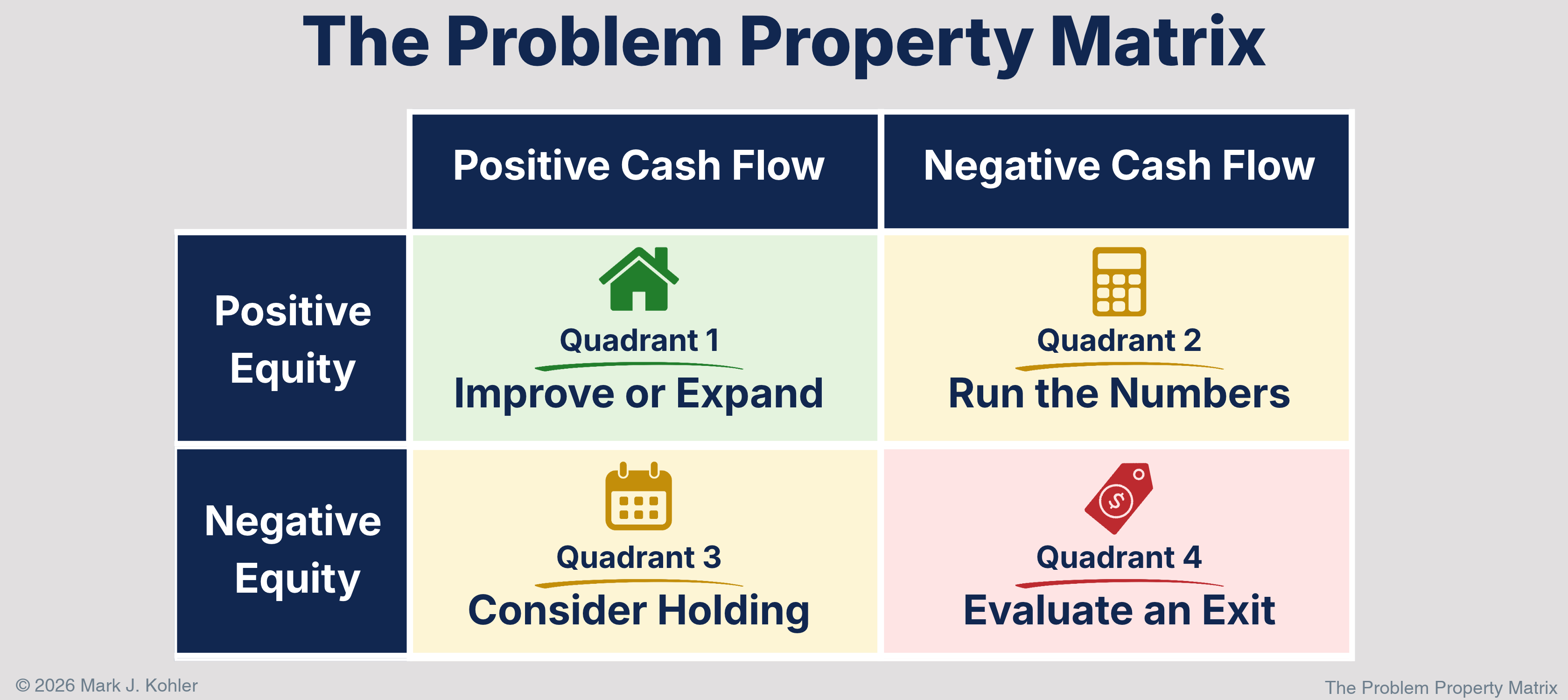
Let's walk through each quadrant and talk about what I would consider doing.
Quadrant 1: Positive Cash Flow and Positive Equity
This is where we want to be. You've got a rental property generating income, and you've built equity along the way. Fantastic! At first glance, you might think there's nothing to discuss. Just keep collecting the rent and watching the equity grow. Well, not so fast.
When a property has both cash flow and equity, I want to look at how we can make that investment work even harder. Could you increase the rent? Improve the property? Add an accessory dwelling unit (ADU) in the backyard? Convert part of the property into another rentable unit? Maybe there's an opportunity to restructure the rental arrangement or make improvements that increase both cash flow and market value.
You should also consider how much equity you've accumulated and whether that money could be used more productively elsewhere. I've always said rental properties are like rabbits. Good rental properties can help create more rental properties. If you've built substantial equity, you may be able to access some of it through refinancing and use those funds toward another investment.
Now, borrowing against a property isn't automatically the right move. You need to consider the new interest rate, debt payments, lending requirements, and whether the additional investment justifies the risk. But the point is that you have options, and you should be evaluating them.
There's another issue I want you to think about: your return on equity. A property generating $2,000 a month in positive cash flow sounds wonderful, but if you've got $800,000 in equity sitting there, is that really the best use of your money?
That's why I don't want you to assume that positive cash flow and positive equity automatically mean you should keep a property forever. You still need to evaluate the overall return and whether another investment could put that equity to better use.
Quadrant 2: Negative Cash Flow but Positive Equity
This is where investors start getting nervous. You've got a property with equity, but the rent isn't covering all the expenses. Every month, you're pulling money out of your own pocket to keep the property afloat, and you're wondering whether it's time to sell.
Let's say you're losing $500 a month. That's $6,000 a year in negative cash flow, and I understand why that would be frustrating. But before you decide the property is a complete failure, I want you to look at what's happening with the mortgage.
If your tenant is paying most of the mortgage payment and the loan principal is going down by $400 or $500 a month, you're still building equity through mortgage reduction. The property might also be appreciating, even if the market is relatively flat right now. Those are real components of your investment return, and they deserve consideration.
Now, that doesn't mean negative cash flow is automatically a good thing. You still have to come up with that $500 every month, and the equity you're building isn't money you can necessarily use to pay your bills. But it does mean we shouldn't jump to the conclusion that the sky is falling simply because the property isn't producing positive monthly cash flow.
The next question is whether you can sustain the shortfall. If that $500 a month is creating serious financial problems, draining your emergency reserves, or causing tremendous stress in your marriage or family, that changes the analysis. I don't care how much appreciation you think you're going to get in three years if you can't afford to hold the property for another six months.
On the other hand, if you can comfortably sustain the negative cash flow and have a reasonable basis to believe the property's value will improve, keeping it may still make financial sense. Maybe a major employer is moving into the area, a new school is being built, or there's infrastructure development that could support future demand. Those are factors worth researching, although appreciation is never guaranteed.
You can also look for ways to change the equation. Could you improve the property and charge more rent? Restructure the lease? Consider a properly structured lease option? Bring in an investment partner who contributes capital in exchange for an ownership interest?
A lease option, for example, may appeal to a tenant who wants the opportunity to purchase the property later. Depending on the terms and market conditions, that arrangement could create additional cash flow. However, the purchase option, rent credits, financing requirements, and legal obligations all need to be carefully documented.
Bringing in a partner is another possibility. You might sell a minority ownership interest and use the proceeds to help support the property while you work toward a longer-term goal. But you're also giving up part of the future appreciation and taking on the legal and financial complexities of a partnership.
The point is that selling isn't your only option. In Quadrant 2, we run the numbers, evaluate the alternatives, and determine whether the potential return justifies the cost and risk of holding the property.
Quadrant 3: Positive Cash Flow but No Equity
Now we've got an interesting situation. Your rental property has lost value, and you may even owe more on the mortgage than the property is worth. That's a terrible feeling, especially if you originally invested a substantial down payment.
But here's my first question: Are you still making money every month?
Let's say your property is underwater by $30,000, but it's generating $400 a month in positive cash flow. You're bringing in $4,800 a year, the tenant is helping pay down the mortgage, and you don't have to come out of pocket to support the investment. Why would you automatically sell?
This is a situation I saw repeatedly after the 2008 real estate crash. Investors were devastated because properties they'd purchased for hundreds of thousands of dollars were suddenly worth substantially less. They wanted to get rid of those properties simply because they'd lost so much equity.
And I would ask them to look at what was happening today rather than what had happened years earlier.
The down payment you made and the value the property used to have are part of your investment history. They're important for understanding your overall financial position, but they don't necessarily tell you whether selling today is the right decision.
If the property is producing positive cash flow, the mortgage is being paid down, and you can manage the ongoing risks, holding it may be a reasonable strategy. Selling an underwater property could actually require you to bring money to closing just to satisfy the mortgage, assuming the lender doesn't agree to another arrangement.
Now, I wouldn't call this a guaranteed return or suggest that having no equity means you've got nothing invested. You still have financial obligations, maintenance expenses, potential assessments, and the risk that the property could lose even more value. But those risks need to be weighed against the income you're currently receiving and the cost of getting out.
In this quadrant, my instinct is generally to consider holding the property while the cash flow remains healthy. Keep managing it properly, maintain adequate reserves, and periodically reevaluate whether the investment continues to make sense.
Don't let the frustration of lost equity push you into a decision that creates an even bigger financial problem.
Quadrant 4: Negative Cash Flow and No Equity
This is the painful one. You've got a property that's losing money every month, and you don't have enough equity to sell it and walk away with a profit. You may even owe more than the property is worth.
And here's what makes this quadrant so difficult. Investors often become convinced that if they can just hold on long enough, they'll eventually get their money back.
They remember the original down payment, the renovations, the years of work, and the equity they had before the market declined. Maybe the property was worth $600,000 at one point, and now it's only worth $450,000. They keep telling themselves the value will come back. Maybe it will. But when?
That's the question I want you to answer. How many months or years will it realistically take for the property to recover enough value to justify continuing to support it? How much additional money will you lose in the meantime? And what happens if the market doesn't recover as quickly as you hope?
I've personally been in this situation. During the 2008 crash, I lost properties, and I've used a deed in lieu of foreclosure to transfer a property back to a lender. Believe me, I know how difficult it is to admit that an investment didn't work out the way you planned.
But here's something I want you to understand. A failed property doesn't make you a failure. Sometimes market conditions, financing costs, unexpected repairs, or circumstances outside your control turn what looked like a good investment into a financial disaster.
And holding on simply because you've already invested so much money can make the situation worse.
You may still have options. Depending on the property and your financial circumstances, you could explore restructuring the debt, negotiating with the lender, bringing in additional capital, arranging a short sale, or pursuing a deed in lieu of foreclosure.
A short sale generally involves negotiating with the lender to accept less than the full mortgage balance from the sale proceeds. A deed in lieu of foreclosure involves voluntarily transferring the property to the lender under an agreed arrangement. Neither is automatically available, and both can have serious credit, legal, and tax consequences. You also need to understand whether any remaining debt will be forgiven or whether you could still face liability.
This is absolutely a situation where I want you getting qualified legal and tax advice before making a decision.
In Quadrant 4, my general recommendation is to stop chasing the loss and seriously evaluate an exit strategy. Don't continue pouring money into a property simply because you can't emotionally accept what has already happened.
Sometimes the smartest financial decision is to rip off the band-aid, deal with the consequences, and move forward.
Before You Sell, Look at the Property's Total Return
Now, there's one more important point I want to make about this entire matrix. Cash flow and equity are the two primary factors we're using to organize the decision, but they aren't the only financial benefits of owning rental real estate.
A rental property can generate returns through four different sources: appreciation, mortgage principal reduction, cash flow, and tax benefits. And depending on your circumstances, those benefits can change the overall analysis.
For example, a property with negative cash flow might still be building substantial equity through mortgage reduction and appreciation. Conversely, a property with positive cash flow and significant equity might be producing a relatively poor return compared with other investment opportunities.
That's why I want you looking at the complete financial picture rather than focusing exclusively on the monthly rent check or the property's current market value.
I've put together a more detailed breakdown of how to calculate rental property ROI using these four returns, including examples of properties with positive and negative cash flow. Understanding those calculations will help you apply the Problem Property Matrix to your own investments and make a more informed decision.
Don't Make a Major Real Estate Decision Based on Emotion
I want to finish with a recommendation that I think is particularly important when you're dealing with a struggling property: Get an objective third party involved.
Maybe you and your spouse disagree about whether to sell. Maybe you're in a partnership, and one person wants to keep the property while the other wants out. Or maybe you're so emotionally attached to the investment that you can't imagine walking away from it.
I've seen these situations create tremendous tension in marriages, families, and business partnerships. Everybody has an opinion, everybody remembers what the property used to be worth, and nobody wants to be the person who admits the investment isn't working.
That's when you need someone who can sit down, look at the numbers, and help you evaluate the options objectively.
What is the property worth today? What's the true cash flow after accounting for expenses and reserves? How much equity would you actually have after selling costs? What are the tax consequences of selling? Could refinancing, restructuring, or changing the rental arrangement improve the situation? And most importantly, what is the best use of your money moving forward?
Those are the questions that should drive your decision.
The Bottom Line
Deciding whether to sell or keep a rental property isn't always easy, especially when you've invested years of work, money, and emotion into it. But the Problem Property Matrix gives you a starting point. Look at your cash flow, evaluate your equity, and understand which of the four quadrants you're dealing with. From there, you can determine whether it makes sense to improve the property, restructure the investment, continue holding it, or finally move on.
If you're struggling with a rental property and aren't sure whether to sell, refinance, restructure, or hold on, I want you to get some objective advice before making another expensive decision. Book a Comprehensive Tax and Business Consultation with my law firm, KKOS Lawyers. We can help you evaluate the tax and legal implications, review your ownership structure, and develop a strategy based on your actual financial situation. Don't spend another year supporting a property that may be holding you back. Get the numbers on the table, understand your options, and make a decision you can move forward with.

Frequently Asked Questions
Should I sell a rental property that's losing money?
Not necessarily. Negative cash flow is a serious concern, but you should also evaluate mortgage reduction, appreciation potential, available equity, and whether you can afford to continue holding the property.
Is it better to sell a rental property or refinance it?
That depends on the property's equity, current financing terms, interest rates, cash flow, and your investment goals. Refinancing can provide access to equity or change your payments, but it can also increase borrowing costs and financial risk.
What if I owe more on my rental property than it's worth?
You may be able to continue holding the property, negotiate with the lender, pursue a short sale, or explore a deed in lieu of foreclosure. Each option has different financial, legal, and tax consequences.
Can I sell a rental property with a tenant living in it?
Generally, yes. However, the existing lease, state and local landlord-tenant laws, and any required notices can affect the sale and the buyer's obligations.
Will I owe taxes if I sell my rental property at a loss?
Not necessarily, but the calculation can be more complicated than comparing the sale price with what you originally paid. Your adjusted tax basis, depreciation, selling expenses, and applicable loss limitations all matter.
Can I use a 1031 exchange when selling a struggling rental property?
Potentially, if the transaction meets the requirements for a like-kind exchange of qualifying investment real estate. A 1031 exchange generally defers eligible gains rather than eliminating them, and it won't automatically solve negative equity or cash flow problems.