




Moving to another state can save you thousands of dollars in taxes. It can also create an expensive mess if you don't do it right. I've worked with business owners and investors who have dramatically reduced their state tax bill simply by changing where they live. I've also seen taxpayers move for all the wrong reasons and end up paying more than they expected.
Before you load the moving truck, let's talk about when moving actually saves money, how to establish a new domicile, and why your former state may still have a claim to your income.
Which States Have No State Income Tax in 2026?
One of the biggest reasons people consider relocating is to eliminate their state income tax altogether.
As of 2026, nine states do not impose a broad individual income tax: Alaska, Florida, Nevada, New Hampshire, South Dakota, Tennessee, Texas, Washington and Wyoming.
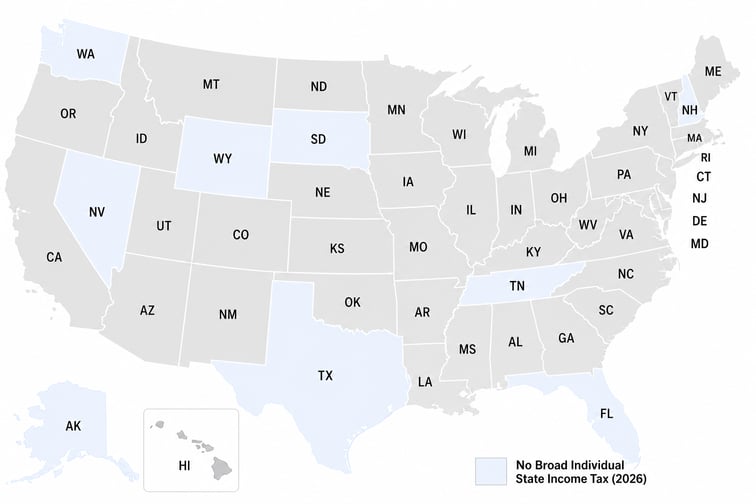
That doesn't mean these states are tax free.
Every state has to generate revenue somehow. Some rely more heavily on property taxes, sales taxes, fuel taxes, tourism, or business taxes. Others make up the difference through higher fees or other types of taxes.
For example, Washington doesn't tax wage income, but it does impose a tax on certain long-term capital gains above specific thresholds. Depending on your situation, that could still affect your overall tax picture. So don't choose a state based solely on one line in a tax chart.
States With the Highest Income Tax Rates
If you currently live in one of the states with the highest income tax rates, the potential savings from relocating may be substantial.
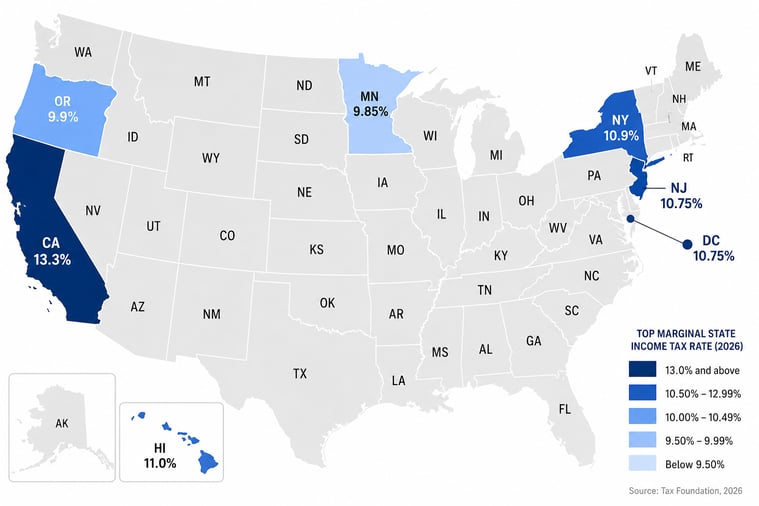
Some of the highest top marginal state income tax rates in 2026 include:
|
State |
Top Individual Income Tax Rate |
|
California |
13.3% |
|
Hawaii |
11.0% |
|
New York |
10.9% |
|
New Jersey |
10.75% |
|
Washington, D.C. |
10.75% |
|
Oregon |
9.9% |
|
Minnesota |
9.85% |
If you're a high-income earner, business owner, or investor, those percentages can translate into thousands, or even hundreds of thousands, of dollars over time. But don't let this be the only factor you consider.
Don't Look at Income Tax Alone
Don’t just compare one state's income tax rate to another and assume you'll come out ahead. That's only one piece of the puzzle.
I've had clients tell me they're moving because they'll save 8% in state income tax. Then we build a spreadsheet and discover they'll spend more on housing, insurance, property taxes, or everyday expenses than they'll actually save. Before making a move, compare the entire financial picture.
In addition to state income tax, look at factors like:
- Property taxes
- Sales taxes
- Business taxes
- Homeowners insurance
- Cost of housing
- Fuel taxes
- Vehicle registration fees
- Estate or inheritance taxes, if applicable
- The cost of the move itself
I love spreadsheets, and this is exactly the kind of decision that deserves one. Run multiple scenarios. Compare your current situation with your proposed move. Be realistic about your lifestyle and your future plans. You may discover that moving saves far more than you expected. Or you may realize you're better off staying exactly where you are. Either way, you'll be making the decision based on facts instead of assumptions.
Residency vs. Domicile: What's the Difference?
People often use the words residency and domicile interchangeably, but they're not always the same thing. And if you're moving to save on taxes, understanding the difference is critical.
Think of it this way. You can have several residences. You might own a home in Arizona, spend summers in Idaho, and rent a condo in Florida. But you can only have one domicile. Your domicile is your permanent home. It's the place you intend to return to after traveling or living elsewhere. It's where your life is centered, and that's what state tax agencies are trying to determine when they question whether you've actually moved.
If you're moving to another state to reduce your taxes, simply buying a house or signing a lease isn't enough. Your actions need to match your intentions. That's why changing your domicile requires creating a consistent picture that shows you've truly made your new state your permanent home.
How to Establish a New Domicile
Every state has its own laws, and some are much more aggressive than others when it comes to auditing former residents. There’s no universal checklist that guarantees you’ve changed your domicile. I like to think of it as a two-part process: sever your ties with the state you’re leaving and establish real ties with the state you’re moving to.
It can also help to establish a clear cutoff date for your move. That might be when you close on your new home, sign a new lease, move your belongings, or otherwise make the new state your permanent home. From that point forward, your actions should consistently show that you actually live there. You’re not just changing an address on paper. You’re moving your life.
If you’re serious about making the move, you should:
- Purchase or lease a primary residence in your new state.
- Obtain a driver’s license in your new state.
- Register your vehicles there.
- Register to vote in your new state.
- Update your mailing address with the IRS, Social Security Administration, banks, credit cards, insurance companies, and investment accounts.
- Move your primary physicians, dentists, accountants, attorneys, and other professional relationships whenever practical.
- Join local organizations, clubs, churches, gyms, or community groups.
- Update your estate planning documents if they reference your state of residence.
- File any required final resident tax return in the state you’re leaving.
- Keep documentation showing exactly when the move occurred.
At the same time, look at the ties you’re leaving behind. Are you selling your former home or ending a lease? Where are your vehicles kept? Where do you spend most of your time? Where are your strongest personal and financial connections? You want the facts to tell the same story: you left one state and genuinely made another state your home.
Most importantly, actually live there. That sounds obvious, but it’s where people get themselves into trouble. You can’t claim Florida is your new home while your everyday life still revolves around California. You need to make a real move and have the paper trail to prove it.
Create a Life, Not Just a Paper Trail
Don't move your paperwork. Move your life. State tax auditors aren't just looking at where your driver's license was issued. They're looking at the entire picture.
Questions they might ask include:
- Where do you actually sleep most nights?
- Where does your spouse live?
- Where do your children attend school?
- Where do you receive medical care?
- Where are your vehicles kept?
- Where do you attend religious services?
- Where are your personal belongings located?
- Where do you spend holidays?
- Where is your business managed?
No single factor determines your domicile. Instead, auditors look at all of the facts together to decide whether your move was legitimate. The more your actions support your new domicile, the stronger your position becomes.
Moving Yourself Isn't Always the Same as Moving Your Income
Here's another mistake I see all the time. People assume that once they move, every dollar they earn is suddenly tax-free from their former state. That's not how state taxation works.
Many states continue taxing income that's earned within their borders, even after you've become a resident somewhere else. Let's look at a few examples.
Example 1: Rental Property
Let’s say you move from California to Texas but keep a rental property in California. Even though Texas doesn't have a state income tax, California generally continues to tax the rental income generated from California real estate. The property is still located there. The income is still sourced there. California still wants its share.
Example 2: Business Owners
Now let's say you own a business operating in Oregon but move your family to Nevada. Moving your residence doesn't automatically move your business. Depending on how your company is structured, where employees work, where sales occur, and where the business has nexus, part of your income may still be taxable by Oregon.
Business owners have more planning opportunities than employees, but they also have more complexity. That's why this is a conversation worth having before you move, not after.
Example 3: Remote Employees
Remote work has created a lot of confusion. In most cases, your wages are taxed by the state where you physically perform the work. But there are important exceptions.
A handful of states have special rules that can require remote employees to pay tax to the state where their employer is located, even if they work somewhere else. Other states have reciprocity agreements that affect withholding and filing requirements.
If you're planning to move to reduce your state income taxes while keeping the same job, don't assume your tax bill will automatically change. Your employer's location, your work location, and the laws of both states all matter. Before making a move, talk with a qualified tax professional to understand how the rules apply to your situation.
Timing Matters
One question I hear all the time is "Can I move in December and avoid state taxes for the entire year?" Usually, no.
Most states determine residency based on when you actually changed your domicile during the year. That means the timing of your move matters. Move early enough, document it properly, and you'll generally maximize your potential tax savings. Wait until the end of the year, and your tax benefit may be much smaller than you expected.
Planning ahead almost always produces a better result than trying to clean things up after the fact.
States That Aggressively Audit Former Residents
Not every state is eager to let taxpayers walk out the door. If you're leaving a high-tax state like California or New York, expect more scrutiny than you might receive elsewhere. Those states have a significant financial incentive to make sure people who claim they've moved have actually done so. I've seen clients underestimate just how thorough these audits can be.
Auditors may review everything from real estate records and driver's licenses to voter registration, utility bills, credit card transactions, and other documents that help establish where you actually lived. The question they're trying to answer is whether you really moved, or if you just changed your mailing address.
The best defense is making a genuine move and keeping good records that support it.
The 183-Day Rule Isn't the Whole Story
One of the biggest misconceptions about changing residency is that you only need to spend more than 183 days in your new state. Again, it's not that simple.
Many states use a 183-day threshold as part of their residency rules, but spending fewer than 183 days in your old state doesn't automatically mean you've changed your domicile. Remember, domicile is about more than counting days.
State tax agencies look at where you've established your permanent home and where the center of your personal and financial life is located. The number of days you spend in a state is important, but it's only one piece of the puzzle.
Special Considerations for RV Owners and Digital Nomads
Living on the road has become more popular than ever. Whether you're traveling in a motorhome, fifth wheel, travel trailer, or simply working remotely while exploring the country, you still need a legal domicile.
Many full-time RV owners choose states like South Dakota, Texas, or Florida because they're RV-friendly and don't impose a broad individual income tax. That can be a great strategy. But don't assume using a mail-forwarding service or registering your RV in another state automatically changes your domicile.
You'll still want to build as many connections to your new state as possible by obtaining a driver's license, registering to vote, updating your financial accounts, receiving medical care there when practical, and documenting your move. The stronger your ties to your new state, the easier it becomes to demonstrate that you've genuinely changed your domicile.
Common Mistakes to Avoid
If you're moving to save on state income taxes, avoid these common mistakes:
- Assuming changing your mailing address is enough.
- Failing to update your driver's license and voter registration.
- Spending most of your time in your former state.
- Forgetting that rental properties and businesses may still create taxable income in another state.
- Ignoring property taxes, sales taxes, insurance costs, and other expenses when comparing states.
- Waiting until year-end to start planning your move.
- Failing to keep records documenting when and how your move occurred.
A little planning now can save you a tremendous amount of time, money, and frustration later.
The Bottom Line
Moving to another state can save you thousands in taxes, but only if you have a plan. Before you change your residency, make sure you understand how your income will be taxed, what it takes to establish a new domicile, and whether the move actually makes financial sense.
Before you pack up and assume a lower-tax state automatically means a lower tax bill, book a Comprehensive Tax and Business Consultation with my law firm, KKOS Lawyers. We can look at your income, business and investments, entity structure, and overall tax picture to evaluate how the move fits into your bigger tax strategy and identify other planning opportunities you may be missing.
Then make sure you have the right tax professional helping you implement the plan. Find a Main Street Certified Tax Advisor trained and certified by me to speak my language and understand proactive tax planning.
Don’t move your entire life based on a tax assumption. Run the numbers and build the strategy before you change your residency, not after.
.png?width=6440&height=1438&name=KKOS%20Book%20a%20Call%20(2).png)
Frequently Asked Questions
Can I move to another state just to avoid state income tax?
Yes. There's nothing illegal about moving to reduce your taxes. However, you must legitimately establish your new domicile and comply with your former state's residency rules.
Can my former state still tax me after I move?
Yes. Many states continue taxing income that's earned within their borders. Rental income, business income, and certain other types of state-sourced income may remain taxable even after you've established residency elsewhere.
How do I prove I've changed my domicile?
No single document proves your domicile. States typically look at the totality of the circumstances, including where you live, where you're registered to vote, where your vehicles are registered, where you receive mail, where your family lives, and where your personal and financial life is centered.
How many days do I need to spend in my new state?
There's no universal answer. While many states use a 183-day rule as part of their residency laws, changing your domicile involves much more than simply counting days. Your overall facts and circumstances are equally important.
Is moving to another state worth it?
It depends. For some taxpayers, especially business owners, investors, and high-income earners, the long-term tax savings can be substantial. For others, higher housing costs, property taxes, insurance, or other expenses may offset the income tax savings.
The only way to know is to compare the complete financial picture before making the move.