

Let me save you time and money right out of the gate. In almost every situation, you should not be using an LLLP. In 25 years of structuring entities for business owners and real estate investors, I have yet to find a situation where an LLLP was clearly superior to an LLC, LP with a proper structure, or an S corporation layered correctly.
Yes, LLLPs still exist. Yes, roughly 30 states plus D.C. recognize them. No, that does not mean they’re always a good idea.
Understanding the Partnership Family
Before we talk about why the LLLP rarely makes sense, let’s quickly review how it fits into the partnership world.
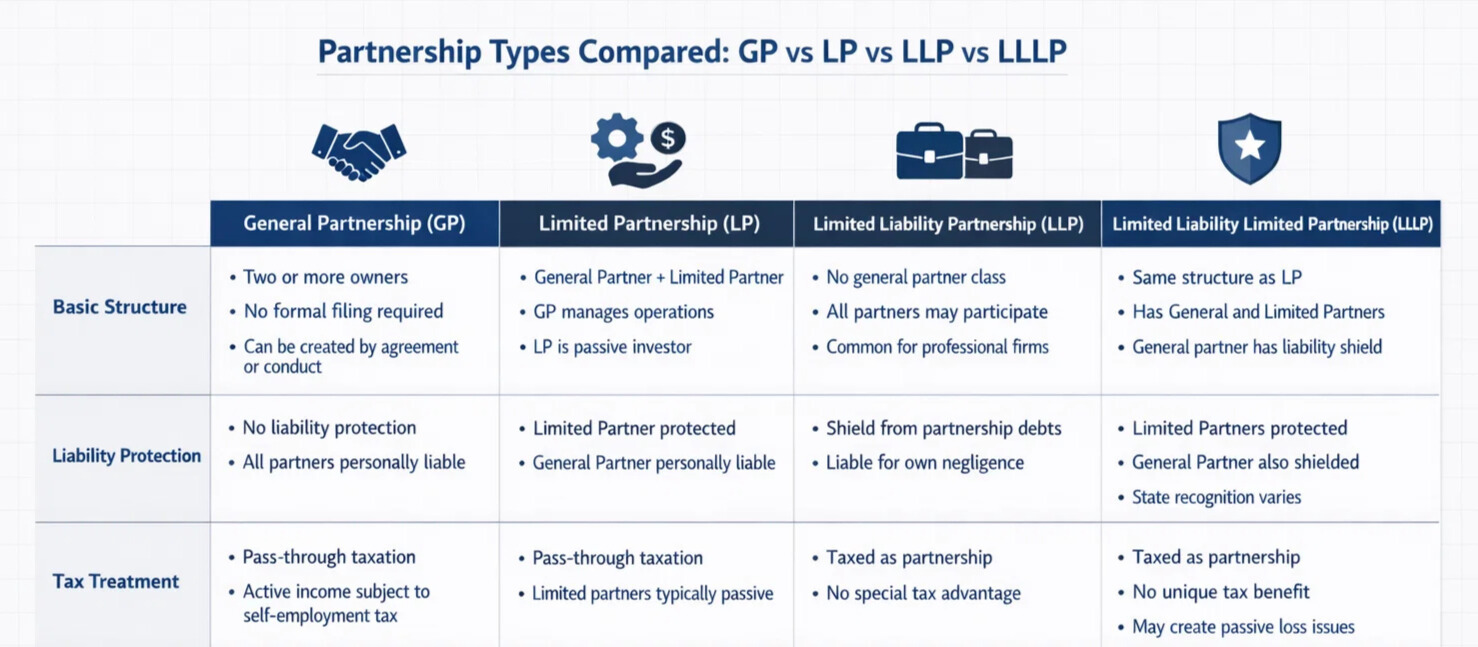
General Partnership (GP)
A general partnership is the oldest form of doing business. Two people agree to work together and share profits. That’s it. It can be created by a contract, an email exchange, or even a handshake.
It also provides zero asset protection. Each partner is personally liable for everything. Lawsuit, debt, vendor dispute, employee claim. It all flows straight through to personal assets. From a tax standpoint, it’s a pass through entity, but without additional structuring, there are no meaningful tax advantages.
Limited Partnership (LP)
In a limited partnership, you have two classes of partners. The limited partner puts up capital and stays passive. The general partner runs the show.
The limited partner is not personally liable beyond their investment. The general partner is personally liable for everything. That’s the problem.
The standard solution has always been to create a separate LLC or corporation to serve as the general partner. That way, the human being is not exposed. When structured properly, an LP can still be useful in certain estate planning and asset protection strategies. However, for operational businesses and most real estate investors, there are cleaner options today.
Limited Liability Partnership (LLP)
The LLP was originally developed for professional firms like lawyers, accountants, doctors, and architects who wanted partnership tax treatment without being personally liable for another partner’s malpractice. Instead of having a general partner with automatic unlimited liability, partners in an LLP generally receive a liability shield from partnership level debts and obligations. That said, no one is protected from their own negligence or misconduct.
Now, here’s where it gets state specific.
Some states restrict LLPs primarily to licensed professional practices. Other states allow a broader range of businesses to use them. Because of that variability, the LLP is not a consistent or predictable solution for real estate investors or typical operating businesses across the country. You cannot assume your state treats LLPs the same way as another.
From a tax standpoint, nothing magical happens. An LLP is still taxed as a partnership unless another election is made. The real difference is liability treatment, not tax benefits. And in most cases today, an LLC provides similar liability protection with simpler administration and broader state recognition.
Limited Liability Limited Partnership (LLLP)
The LLLP was created to eliminate the automatic personal liability of the general partner in a limited partnership. In theory, both general and limited partners receive liability protection similar to what LLC members receive.
On paper, that sounds appealing. In practice, it creates more questions than benefits.
The Real Problem with LLLPs
The biggest issue with the LLLP is that it solves a problem we already know how to solve.
If you are using a limited partnership and you are concerned about the general partner’s liability exposure, the standard strategy is to have an LLC serve as the general partner. That creates an extra layer of protection without introducing a new and less tested entity type.
Why experiment with a newer statutory structure when the LLC solution is already established, widely recognized, and respected in every state?
LLLPs also create state law complications. Not every state recognizes the LLLP structure. As of 2026, just over 20 states have specific LLLP statutes. If you are operating in a state that does not recognize LLLPs, you cannot register as a foreign LLLP there. That creates real risk.
Do not assume that the Full Faith and Credit Clause magically forces one state to honor another state’s LLLP protections. That is not how courts consistently treat these issues. You do not want to become the test case.
LLLP Tax Issues
From a tax standpoint, the LLLP offers no unique advantage.
It is generally taxed as a partnership. That means operational income flows through and is subject to self employment tax unless structured properly. If you are running an active business through an LLLP, you are likely facing full self employment tax exposure on your distributive share.
If you want to mitigate self employment tax, the conversation usually turns to S corporation planning, not LLLPs. That can be done by having ownership interests held through an S corporation where appropriate. But again, that can be done without an LLLP.
For real estate investors, the situation is even more problematic. The IRS has historically treated limited partnership interests as passive unless the partner qualifies under specific material participation rules. There is no clear authority suggesting that an LLLP magically converts passive losses into non passive losses.
If you qualify as a real estate professional and want maximum flexibility in grouping and deducting rental losses, an LLC structure is typically cleaner and more predictable.
Why the Hype?
LLLPs tend to resurface every few years because they sound sophisticated. They sound like the “next level” entity. Promoters sometimes package them as a superior asset protection vehicle. But complexity is not strategy.
In most situations, an LLC provides equal or better liability protection, simpler administration, better multi state recognition, and fewer tax headaches. If an LP is truly appropriate for estate planning reasons, such as a family limited partnership scenario, the traditional solution of using an LLC as the general partner remains effective and widely accepted.
Canadian Investors and LLLPs
For years, Canadian investors used LLLPs as a workaround when buying U.S. real estate. The idea was simple. LLCs can create classification mismatches between the U.S. and Canadian tax systems, potentially leading to double taxation. The LLLP was viewed as a cleaner partnership alternative. That changed.
The Canada Revenue Agency issued guidance concluding that certain U.S. LLPs and LLLPs may be treated as corporations for Canadian tax purposes. When that happens, you no longer have matching partnership treatment on both sides of the border. Instead, you can trigger foreign affiliate reporting obligations and exposure to double taxation if the structure is not carefully coordinated.
In other words, the old “LLLP solves the Canadian problem” pitch is outdated.
As of 2026, cross-border planning requires careful coordination between U.S. and Canadian advisors who understand entity classification rules in both jurisdictions. An LLLP is not automatically safer than an LLC, and in many cases, it creates the same or even more complicated reporting and tax issues.
If you are a Canadian investor buying U.S. property, this is not a do-it-yourself situation. The wrong entity can cost you far more in compliance and tax than the upfront structuring fee you were trying to save.
When Would I Use an LLLP?
Almost never.
If you're a business owner, an LLC combined with proper tax elections often makes more sense. If you're seeking S corporation tax treatment, that election can be layered onto an LLC without introducing an LLLP.
If you're building an estate planning structure involving family wealth transfers, a properly structured LP with an LLC as the general partner remains more predictable and defensible.
The LLLP just doesn't provide a meaningful advantage that justifies the added complexity and jurisdictional uncertainty.
The Bottom Line
The LLLP isn’t illegal and it’s not automatically wrong. It’s just rarely the best tool available. Before forming one, make sure you understand whether it’s recognized in your state, how it will be taxed, how it interacts with self-employment tax, and whether a simpler LLC structure would accomplish the same goal with fewer moving parts.
If you’re considering an LLLP or simply aren’t sure which entity belongs in your overall structure, book a Comprehensive Entity Set-Up with my law firm, KKOS Lawyers. We can look at your business, investments, liability exposure, tax considerations, and long-term plans and determine which entity structure actually makes sense for what you’re trying to accomplish.
Don’t collect entity types just because they sound sophisticated. Build the right structure from the beginning so you’re not paying to untangle the wrong one later.
.png?width=6440&height=1438&name=KKOS%20Book%20a%20Call%20(2).png)
FAQs About LLLPs and Partnerships
What does LLLP stand for?
LLLP stands for Limited Liability Limited Partnership. It is a variation of a limited partnership where both the general partner and limited partners receive a liability shield under state statute.
What are the four types of partnerships?
The four main partnership types are:
• General Partnership (GP)
• Limited Partnership (LP)
• Limited Liability Partnership (LLP)
• Limited Liability Limited Partnership (LLLP)
Each structure offers different liability protection and administrative requirements, but all are generally taxed as pass-through entities unless another election is made.
Is an LLLP the same as an LLP?
No. An LLP does not have a general partner class with automatic unlimited liability. All partners generally receive liability protection from partnership debts.
An LLLP, on the other hand, keeps the traditional limited partnership structure with general and limited partners, but extends liability protection to the general partner as well.
Is an LLLP better than an LLC?
In most cases, no. An LLC typically provides similar or stronger liability protection with simpler administration and broader recognition across all states. For most business owners and real estate investors, an LLC is cleaner and more predictable than an LLLP.
Who owns an LLLP?
An LLLP is owned by partners. There are general partners and limited partners. Ownership percentages are determined by the partnership agreement.
Are there tax benefits to forming an LLLP?
No unique tax benefits. An LLLP is generally taxed as a partnership. It does not automatically reduce self-employment tax or create special deductions. Tax outcomes depend on how the business operates and how ownership is structured.
Can real estate investors use an LLLP?
In theory, yes, if their state allows it. In practice, most real estate investors find that an LLC provides similar liability protection with fewer complications and better multi-state recognition.