




If you’ve got kids or grandkids and you’re ignoring Trump Accounts right now, you may want to take a second look. For some families, this is a no-brainer because the government is dropping $1,000 into the account. But even if your kids don’t qualify for the free money, there’s still a strategy here. And that’s where things get interesting.
placeholder
What Is a Trump Account?
A Trump Account is a new type of investment account created for children under age 18. During what the IRS calls the “growth period,” which runs through the end of the year the child turns 17, the account has special contribution and investment rules. After that point, the account generally follows the rules of a traditional IRA.
These accounts officially roll out in July 2026. Once they’re live, parents or guardians can open an account for a child and begin contributing.
The investments inside the account are intentionally limited. The money generally has to be invested in broad U.S. stock index funds or ETFs with very low fees. You’re not trading options or crypto in this thing. The idea is long-term investing and compounding.
Who Gets the Free $1,000?
One of the biggest headlines around Trump Accounts is the government seed contribution. If a child was born between January 1, 2025 and December 31, 2028, the government plans to contribute a one-time $1,000 deposit into the account. That contribution does not count toward the normal annual contribution limit.
If you’ve got a child born during that window, the math is pretty simple. Free money that compounds for 18 years is hard to pass up. Even if you never add another dollar, that initial contribution has the potential to grow significantly over time.
What If Your Kid Is Already 15 or 17?
This is where a lot of parents stop paying attention, and honestly that’s a mistake.
Even if your child doesn’t qualify for the $1,000 seed money, the account can still be useful because contributions don’t require earned income the way a Roth IRA does. That’s a major difference.
Many families love the idea of opening a Roth IRA for their kids, but the child has to actually earn income. If they’re not working or they’re only working occasionally, the amount you can contribute becomes limited. Trump Accounts remove that hurdle.
Parents, grandparents, employers, or even nonprofits can contribute to the account. Current guidance suggests the annual limit will be around $5,000 per child, adjusted over time. That creates an opportunity to start investing for a child even if they’re still focused on school, sports, or simply being a kid.
The main limitation is timing. Contributions generally stop once the child reaches the calendar year they turn 18. If you’ve got a teenager, the window to build that account may only be a few years.
The Real Strategy: Converting to a Roth Later
Where this strategy really starts to shine is what happens years down the road.
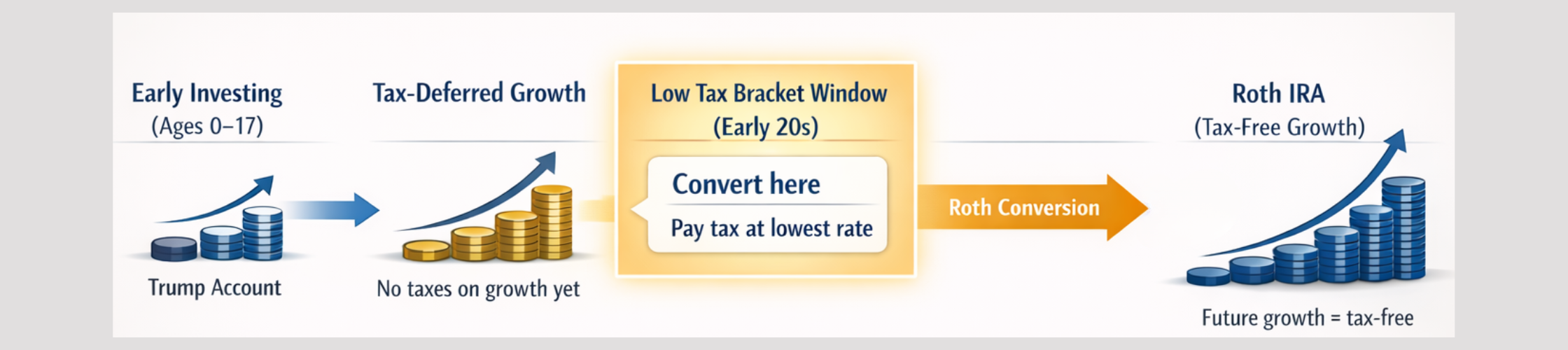
Trump Accounts function similarly to traditional retirement accounts. The earnings grow tax deferred inside the account, but withdrawals could eventually be taxable. At first glance that might not sound exciting, but it creates a powerful planning opportunity.
When the child gets older, potentially in their early twenties, they are often in the lowest tax bracket they will ever see in their lifetime. That’s when a Roth conversion strategy may come into play.
By converting the account to a Roth at that stage, taxes are generally paid only on the earnings portion of the account. Because the child’s income is often very low during those years, the tax cost of the conversion could be minimal. Once the funds are inside the Roth IRA, future growth can come out tax-free.
When you combine early contributions, compounding, and a well timed Roth conversion, the long term tax advantages can become significant.
What About Employer Contributions?
There’s another interesting twist here. Some employers are already exploring programs where they contribute to employees’ children’s Trump Accounts as a benefit. Those contributions can potentially be excluded from the employee’s taxable income up to certain limits.
There’s also discussion around philanthropic contributions and community programs helping fund these accounts for children in certain areas. While those opportunities may not apply to every family, it’s another reason not to dismiss these accounts too quickly.
How This Compares to a Kids Roth IRA
If your child legitimately works in your business, the kids Roth IRA strategy is still one of my favorite moves. Paying a child for real work, taking the business deduction, and funding a Roth IRA with that earned income is an incredible wealth building strategy. But obviously not every child works in a family business, and not every child has earned income.
That’s where Trump Accounts may fill a gap. They create another way to begin investing for a child early without requiring earned income. In some cases families may even use both strategies depending on the child’s age and situation.
What I Like and What I Don’t
There’s a lot to like about the structure of these accounts. The $1,000 government seed money is obviously attractive for eligible kids. The ability to contribute without requiring earned income gives families flexibility they don’t currently have. And the potential for a future Roth conversion creates a long-term tax strategy that could be very powerful.
At the same time, these accounts are still new. The rules are evolving, and the investment options are limited. But that limitation is also part of the design. The focus is clearly on long-term investing rather than speculation.
The Bottom Line
Trump Accounts could become a useful new tool for families who want to start investing for their kids early. The $1,000 government contribution may grab the headlines, but the real opportunity is the long term strategy. Start investing early, let compounding work for years, and consider whether a future Roth conversion could turn that account into decades of tax-free growth.
But like most tax strategies, the details matter. How much you contribute, how the account fits alongside a kids Roth IRA, and when a Roth conversion makes sense all depend on your broader tax situation.
If you want help determining whether a Trump Account fits into your family’s tax and wealth strategy, work with a professional who understands these rules. A Main Street Certified Tax Advisor is specifically trained in the types of strategies discussed in this article and can help you coordinate the right approach for your situation. Visit the Main Street Tax Advisor Network to find a qualified advisor near you who can help you implement the strategy correctly.
Frequently Asked Questions
Can I open a Trump Account if my child doesn’t qualify for the $1,000?
Yes. The account can still be opened for children under 18 even if they don’t qualify for the government seed money. Parents, grandparents, and others can contribute to the account during the child’s eligible years.
Does my child need earned income to contribute?
No. Unlike a kids Roth IRA, a Trump Account does not require the child to have earned income. That’s one reason some families may use it as an additional way to start investing for their kids.
How much can be contributed each year?
Current guidance suggests contributions may be limited to about $5,000 per child per year, with adjustments for inflation over time. Contributions can come from parents, employers, or other approved sources.
What can the account invest in?
Investments are generally limited to broad U.S. stock market index funds or ETFs with low fees. The structure is designed to focus on long term investing rather than active trading.
Can the account later be converted to a Roth IRA?
Potentially, yes. After the growth period ends, the account may follow traditional IRA rules, which could allow a Roth conversion later. Many families may consider doing this when the child is in a lower tax bracket.