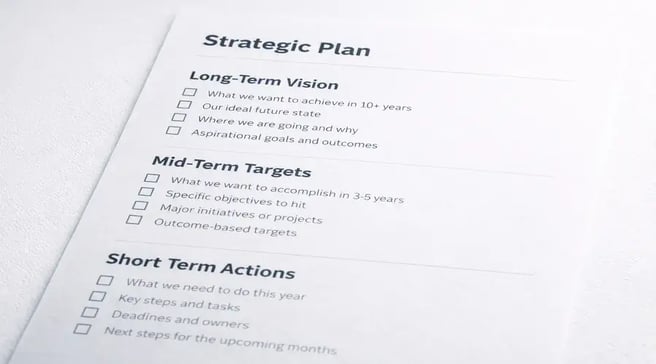




If your “plan” is living in your head, you don’t have a plan. You’ve got hopes, stress, and a bunch of half-finished ideas you’ll swear you’ll get to when things slow down. They won’t. So if 2026 is going to be different, you need a simple process you can write down, schedule, and revisit without turning it into some corporate retreat nonsense.
- Write It Down
- Set Your 10-Year Ideal Scene
- Work Backward to 5, 3, and 1-Year Targets
- Reality Check the Obstacles
- Turn Goals Into Action Items
- Schedule the Work
- Share It for Accountability
- Review Monthly and Adjust
1. Write It Down
Start with pen to paper. Yes, I said pen to paper. Your brain moves faster than your mouth, and your mouth moves faster than your writing. That gap is the secret weapon because it forces you to slow down long enough to actually hear yourself think.
A strategic plan you type in seven minutes while checking email isn’t a strategic plan. It’s a to-do list with confidence. When you write, you process, you prioritize, and you notice the holes. You also catch the fake goals you don’t actually believe in, which is exactly what you want before you waste 6 months pretending you’re “working on it.”
2. Set Your 10-Year Ideal Scene
Before you pick a single goal for 2026, get clear on what you’re building toward. That means writing down your ideal scene for 10 years from now with real details, not vague motivational fluff you’d put on a vision board.
What does the business look like? What’s the revenue and profit margin? What do you sell and who do you serve? Who’s on the team and what’s your role? How many hours are you working and what does a normal week feel like? If your “business” is rental real estate, the same rule applies. How many rentals, what kind, what cash flow, what debt level, and what lifestyle are you building around it?
3. Work Backward to 5, 3, and 1-Year Targets
Once you have the 10-year vision, work backward and build the staircase. If you want 10 rentals in 10 years, what does year five look like? What does year three look like? What should be true by the end of 2026? Same thing if you’re running a service business. If the 10-year target is $5,000,000 in revenue, then year five and year three can’t be guesses. They need to be numbers and milestones.
Give yourself some grace without giving yourself excuses. The path is not always straight. 2026 might not be the year you buy the rental. Maybe it’s the year you kill debt, fix cash flow, clean up your books, and stop operating like chaos is a business strategy. That still counts because it sets you up to actually execute when the opportunity shows up.
4. Reality Check the Obstacles
This is where you stop lying to yourself. What’s holding you back right now? Debt, cash flow, a broken system, a bad habit, a calendar that’s packed with everything except the work that moves the needle, or people in your life who are quietly dragging you down.
If you don’t name the obstacle, it becomes your default excuse for the next 12 months. This is also where you tighten your goals so they’re specific, measurable, achievable, relevant, and time bound. Not because acronyms are cute, but because vague goals are where motivation goes to die. If you need to take two steps back financially to take three steps forward, do it on purpose and put it in writing.
5. Turn Goals Into Action Items
A goal without action items is just a wish with a deadline. Let’s say your objective is to increase revenue from $1,000,000 to $1,500,000 in 2026. Great. Now answer the real question: what has to happen to make that true?
If you say better marketing, define it. Content, ads, email list, referral relationships, speaking gigs, better offers, better follow-up. If you say better sales, define it. Hiring, training, scripts, lead flow, accountability, and yes, sometimes firing the wrong people. Then break it down into bite-size tasks you can actually execute without turning your plan into a 100 item fantasy list.
6. Schedule the Work
If it isn’t scheduled, it isn’t real. Ideas don’t move the ball. Calendar time does. Take your action items and map them into the year, starting with quarters, because sequencing matters more than intensity.
Ask what has to happen in Q1 before Q2 even works. If marketing needs to improve, maybe Q1 is picking a lane and hiring help. If sales need to improve, maybe Q1 is training and cleaning house. If your finances are a mess, maybe January is bookkeeping cleanup and cash flow tracking. You don’t “scale” on top of broken systems. You scale stress.
7. Share It for Accountability
If you keep your plan private, you’re keeping it safe. Safe plans don’t build anything. Share it with someone who will hold you accountable, whether that’s a mentor, a business partner, a mastermind group, or a board of advisors.
And yes, share it with your spouse. If you’re going to push hard in 2026, your household should know what you’re building and why. Nothing creates unnecessary friction like acting like your partner should magically understand your intensity without context. The moment you say the plan out loud, you’ll hear where it’s unrealistic, and that’s a gift because you can fix it now instead of crashing into it later.
8. Review Monthly and Adjust
Your strategic plan should guide your decisions, not sit in a drawer. Look at it monthly and ask one question: am I on track or off track?
If you’re on track, keep going. If you’re off track, decide what changes. More focus, different sequencing, dropping an action item that no longer matters, or pulling another one forward. Waiting until the end of the quarter to check in is how you wake up in October wondering where the year went, so build the review cycle into the plan from day one.
The Bottom Line
A written plan, a real vision, and monthly accountability will beat motivation every time. If you want 2026 to look different, don’t wait for the perfect moment or the perfect mood. Write the plan, break it into actions, schedule it, and force the review cycle. That’s how businesses grow on purpose instead of by accident.
If you want a strategy that actually lines up your tax, legal, and business decisions, book a Comprehensive Tax and Business Consultation with my law firm, KKOS Lawyers. We can help you connect the pieces and turn your goals into a strategy you can actually execute.
Don’t let another year run you. Build the plan and start running your business on purpose.
.png?width=6440&height=1438&name=KKOS%20Book%20a%20Call%20(2).png)